Build vs Buy Automation: A Decision Framework for Enterprise Operations
“Build or buy?” is usually the wrong binary. The better question is which capabilities should be owned, which should be purchased and where composition preserves strategic control.
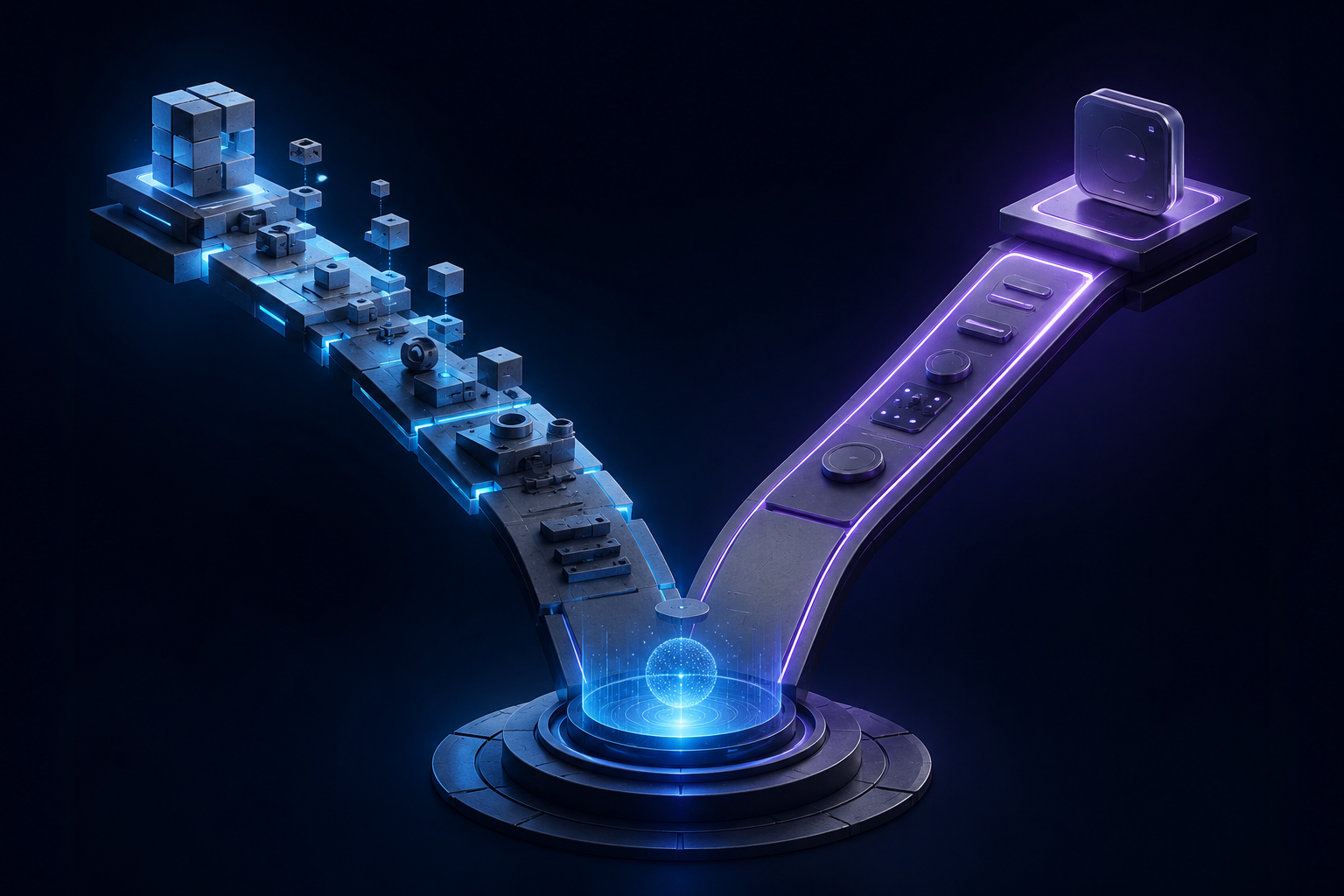
Enterprise automation decisions are often framed as a contest between custom software and a vendor platform. That framing produces weak decisions. Most successful operating systems combine purchased infrastructure, configured platforms, custom integration and proprietary business logic.
The real task is to choose where the organisation should own differentiation and where it should consume a reliable commodity.
For COO, RevOps and IT leaders, the decision should account for more than launch speed. It should address lifecycle cost, control, security, integration, operational ownership and the cost of changing direction.
Decompose the capability first
Do not evaluate “an automation platform” as one object. Break the use case into capabilities:
- user experience and case management;
- workflow orchestration;
- connectors and API management;
- business rules and decision logic;
- AI model access and evaluation;
- identity and permissions;
- data storage and retrieval;
- observability and audit;
- exception operations;
- deployment and lifecycle management.
Each layer may deserve a different choice. A company can buy identity, use a managed workflow service, build proprietary decision logic and retain its own audit store. This composable view prevents a vendor suite from absorbing logic that should remain portable.
Identify genuine differentiation
Build where the capability embodies a business advantage that cannot be expressed adequately through configuration or extension.
Examples may include a distinctive fulfilment policy, a unique risk model or a process that creates customer value unavailable from standard software. Even then, build the smallest differentiating layer. Authentication, queues, logging and generic admin screens rarely differentiate the business.
Buy when the capability is common, mature and expensive to operate well: identity, commodity communications or standard CRM functions. Vendor scale can provide maintenance and compliance investment that an internal team would otherwise need to reproduce.
Be sceptical of “our process is unique.” Sometimes uniqueness reflects historical workarounds rather than strategy. Simplifying the process to fit a strong standard product may create more value than encoding every exception.
Compare time to evidence, not time to demo
A vendor can often produce a fast demonstration. Custom development can also prototype quickly. Neither proves production fitness.
Measure time until the organisation can obtain evidence of:
- correct completion using representative data;
- manageable exception workload;
- acceptable security and access control;
- observable performance and reliability;
- user adoption;
- integration with systems of record;
- a credible total cost profile.
A short, reversible pilot should test the riskiest assumptions. Do not spend the pilot reproducing the vendor’s polished happy path.
Model total cost over the lifecycle
For a purchase, include licences, usage, premium connectors, environments, support, implementation partners, data egress and expected price sensitivity as volume grows. Add internal product ownership, governance and integration maintenance.
For a build, include discovery, engineering, design, testing, security, infrastructure, support, on-call responsibility, documentation and succession risk. Custom software requires ongoing product management; “finished” code still depends on changing APIs, policies and user needs.
For both choices, estimate migration and exit cost. A low initial price can hide expensive data extraction, workflow recreation or retraining later.
Use scenarios rather than one forecast. Model expected transaction growth, AI inference usage, exception staffing and vendor price changes. Compare cost per successful business outcome, not merely cost per user or workflow run.
Evaluate control and risk
Create a control matrix covering:
- data location, retention and deletion;
- identity, roles and separation of duties;
- encryption and key management;
- auditability and log export;
- vulnerability and dependency management;
- availability and recovery;
- model and prompt change control;
- incident notification;
- subcontractors and supply chain;
- regulatory and contractual obligations.
For vendors, require evidence and contract terms appropriate to the risk. For custom builds, assign who will implement and continuously operate each control. “We control the code” is not the same as controlling security or reliability.
NIST’s Secure Software Development Framework provides a common language for secure development and acquisition. Use it to examine both internal practices and supplier expectations. If generative AI is developed or integrated, NIST SP 800-218A adds AI-specific secure development considerations.
Test integration depth
A connector catalogue is not an integration strategy. Check whether connectors support the objects, triggers, authentication methods, pagination, rate limits and write operations the process actually needs.
Ask what happens when a vendor changes an API, a credential expires or a record fails validation. Can the platform preserve idempotency, expose raw errors and replay safely? Can it propagate correlation identifiers? Can logs be exported into the organisation’s monitoring environment?
If a platform hides these details, it may be suitable for low-risk departmental automation but not for a critical transaction.
Protect architectural options
Portability does not require pretending every component can be swapped instantly. It requires deliberate seams.
Keep business rules in version-controlled artefacts where feasible. Use documented APIs and standard event formats. Separate canonical business records from platform-specific execution metadata. Export audit and performance data. Avoid scattering secrets and credentials across individual workflows.
Create an exit plan before signing a strategically important contract. Document data export, workflow inventory, intellectual-property ownership, termination assistance and the operational fallback if the service becomes unavailable.
Decide whether you can operate what you build
Custom development is justified only if the organisation can own the resulting service. That means product ownership, engineering maintenance, security response, observability, support and roadmap decisions.
Bus-factor risk is material. If one developer understands the orchestration, the company does not truly own the capability. Require documentation, automated tests, deployment repeatability and knowledge transfer.
Conversely, buying does not remove the need for ownership. Someone must govern configuration, permissions, vendor changes, adoption, data quality and benefits. A neglected platform becomes expensive shelfware or uncontrolled shadow infrastructure.
Use a weighted decision record
Score options against criteria agreed before vendor demonstrations. Possible dimensions include:
- strategic differentiation;
- functional fit;
- integration fit;
- security and compliance evidence;
- reliability and support;
- time to evidence;
- three-year scenario cost;
- internal capability;
- portability and exit cost;
- vendor viability and roadmap fit.
Weight criteria by use-case importance. Record evidence, assumptions and dissent. The decision record prevents later debate from relying on memory and helps teams revisit the choice when conditions change.
Prefer build, buy or compose according to the evidence
Build when differentiation and control are high, requirements are stable enough to encode, and the organisation can operate the service.
Buy when the capability is mature and non-differentiating, the vendor provides strong fit and evidence, and switching risk is acceptable.
Compose when the business needs speed from managed components but must retain proprietary logic, data control or portability. For many enterprise automation programmes, composition is the most realistic answer.
Set review triggers: material volume change, new regulation, repeated reliability failure, major price movement, acquisition, vendor roadmap shift or a new strategic capability. Build-versus-buy is not a permanent identity; it is a decision made under current evidence.
The best architecture owns what makes the organisation distinct and rents what others can operate better—while preserving a safe path to change.
CTA
Run a build–buy–compose decision sprint with Nodvia. We map the capability layers, risk controls, lifecycle economics and exit options, then define a production-minded pilot.